Seeing Phonemes
Reading science centers on speech sounds, but DHH learners reveal that phonology can be visual. Early language access—not acoustics alone—builds the bridge to print literacy.
In Seeing Language, my previous post about ASL, I suggested that sign language may provide us with an intriguing lens for language, literacy, and cognitive inquiry, and offer us a window into the complexities of multilingualism, as well as how we define and accommodate disability.
In a continuation of that inquiry, let's dig into how children who are deaf and hard of hearing (DHH) learn to read -- and how reading instruction may be similar to and different from what we typically describe.
The Phonocentric View of Reading Science
A few years ago, in The Science of Reading Across Languages, I shared an important critique leveled by David Share: that reading science is Anglocentric.
A further critique we can level is that reading science -- and instruction -- is phonocentric. The entire focus is on the conversion of speech sounds to print and vice versa. All within an environment in which there is quite a lot of talking by adults.
My own narrative on learning to read thus far has been, in a nutshell: kids are equipped with the cultural technology of an alphabetic writing system via the (initially) effortful breaking apart of the stream of sounds within a word. Ideally, that word is already present in their vernacular. The goal is to be able to then transmute those words back and forth between oral and written form. Students must practice and apply this breaking apart and putting back together -- both explicitly with specific words, and implicitly with connected text, all introducing them to new words beyond their everyday use-- until the stream of words on a page can flow into their minds with the ease of the language they are able to speak and to hear.
Language -- as Mark Seidenberg so aptly put it -- at the speed of sight.
At the center of such effortful practice and instruction in English reigns the phoneme, the smallest, abstracted unit of sound that can be mapped unto a grapheme.
Now, we could complicate that narrative, as Share does, by pointing out that the fulcrum shifts when moving beyond an Anglocentric view depending on the nature of the language in question and its mapping onto its accompanying writing system. Explicit instruction and practice with phonemes, for example, are far less important in non-alphabetic writing systems and in languages where phonemes map more directly onto graphemes. But all writing systems, including the Chinese writing system, do rely upon a phonological connection in tandem with morphological awareness, so there are some universals across learning to read in different languages, as we've also explored previously (via a paper by Verhoeven and Perfetti).
And yet: what happens when we consider a child who is unable to hear that fundamental element of transposition, that visceral yet synthetic node that concatenates spoken language into written language? Note that this consideration was not present in that paper nor my earlier post about it, thanks to phonocentrism.
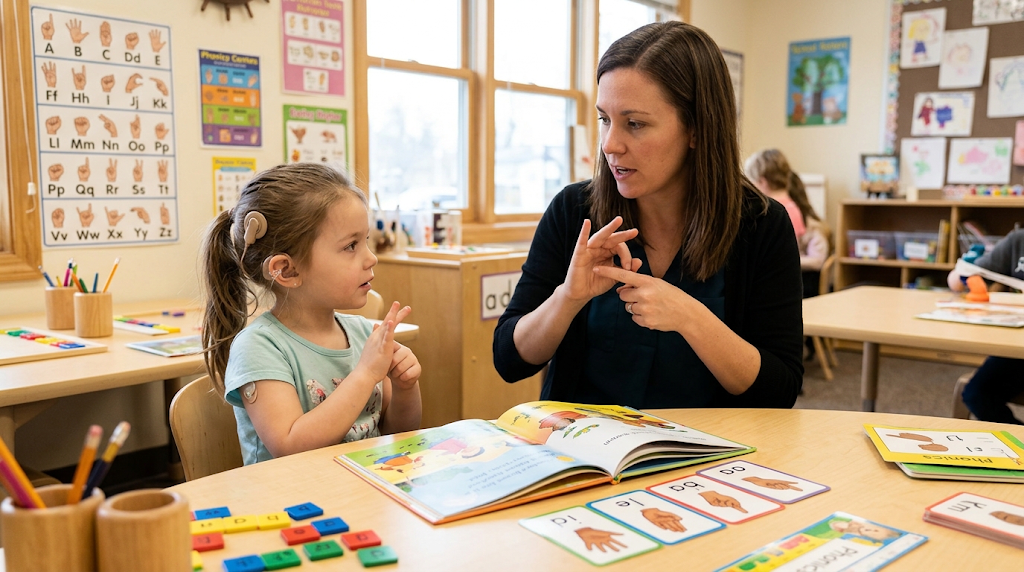
I witnessed some moments of the delicate balance between phonocentric instruction and ASL access in a kindergarten lesson at the school I mentioned in my last post: a deaf child was stuck on a word during a phonics lesson, and as the teacher went back through the sounds, an ASL interpreter simultaneously recast the word letter by letter through fingerspelling. The hand was doing the work a hearing child's ear does as they listen to, watch, and mimic their teacher mouthing phonemes.
William Stokoe -- a professor whose research led to the belated recognition in the 1970s and 80s of ASL as a fully formed and legitimate language -- challenged the assumption that phonology is inherently auditory. He demonstrated that in ASL, phonology is visual and spatial, composed of discrete sublexical parameters (more things to know about ASL in this guide I shared in my last post!). Just as phonemes are combined to build spoken words, these visual parameters combine to build signs.
ASL does not have a widely used, standardized written form. Similarly, some oral languages do not have a standardized written form, such as Pirahã, Romani dialects, or indigenous languages in Papua New Guinea. In other words, for children whose primary home language is ASL, learning to read and write occurs not only across new modalities but as an acquisition of an entirely new language (English).
I think we will find that we can continue to see those universals across all languages, so long as we are able to expand our range of consideration (beyond phonocentrism) to include visual and spatial communication as a part of it.
That said, note that in this and other posts, when I reference signed and spoken languages, I will mostly write from the perspective of where I live and work, which is in the United States, thus assuming or explicitly stating English and ASL. Insert the relevant spoken and signed languages of your context and let me know what differs.
Phonemic Awareness Beyond Acoustics
The basis of any communicative system, when you boil it down, is the linking of a thing to something which it is not, but which becomes a stand-in via association: the sound, sign, or group of letters that represents the thing.
When learning more than one language, such associations become multilayered. One thing can be represented in multiple ways, with sounds or symbols that may or may not be similar depending on their distinct origins within linguistic and geographical human migration and evolution.
But for children navigating print without access to mainstream spoken language, these associative pathways can diverge in a wide variety of ways. While educational systems may first categorize DHH children under the framework of disability, DHH children must also be understood as multilingual learners whose unique linguistic profiles require culturally and linguistically responsive instruction.
For such diverse profiles of learners, we can never rely on a static data point to determine what kind of instructional supports are needed.
The Bottleneck of Language Deprivation
Before moving into DHH-related subgroups and profiles, it's worth pausing here to expand on what is a spectre in the room for a large number of DHH children, given that a large majority are born to hearing parents. They may not have full access to either a spoken or signed language during the critical early years from birth to 5.
While this can be understood as a social, cultural, and economic barrier rather than strictly a biological one, language deprivation poses a real challenge for literacy development.
Because one of the most robust findings on literacy development may be the following formulation (my own words):
Lots of social, linguistic interaction from womb to age 5 + a print rich environment + read-alouds = strong basis for future literacy development.
I've waxed prosodic before about the notion of an "inner scaffold," an innate topsoil in our minds unfurled by dialogic, multimodal interaction and refined through increasingly "decontextualized," or academic, language and literacy. Children who lack early access to a formal signed or spoken language and rely solely on home signs present us with the critical case of a topsoil left untended, and the subsequent challenge of cultivating literacy once that critical neurological substrate begins to harden.
In a meta-analysis of 57 studies (Mayberry, del Giudice, & Lieberman, 2011), phonological skills accounted for roughly 11% of the variance in deaf students' reading. Language ability accounted for about 35%. Deaf children who get robust, accessible language early, such as deaf children of Deaf parents, move more swiftly towards parity with hearing peers.
So a visual route for learning to read can work. What provides a barrier to reading isn't that children can't hear the sounds or just that sign language is an entirely different language from English. It's that some DHH kids may come to print without sustained language access beforehand.
The Heterogeneity of DHH Readers
For this section, please note that I am writing as an outsider to Deaf communities and without any first-hand knowledge. Please let me know where I am confused or inaccurate.
A key distinction among subgroups of readers seems to lie between two axes: functional access to linguistic input, and the age at which they learn a formal signed or spoken language. Each variable bears differing implications for how the English writing system maps onto their inner scaffold:
- DHH Children of Deaf Parents Who Sign: A small percentage of DHH children (a reminder that the majority of DHH children are born to hearing parents), these learners are exposed to and develop a fully accessible visual language (such as ASL) from birth. They face little risk of language deprivation and typically possess a more robust first language foundation to build upon as they learn English as a new language and to read and write in English.
- DHH Children of Hearing Parents Who Learn to Sign: Some hearing parents begin learning sign language shortly after their child's diagnosis, providing emergent access to shared communication, but often without the level of lexical depth, prosody, and linguistic complexity provided by Deaf signing parents.
- DHH Children with Early Access to Acoustic Technology: DHH children with congenital hearing loss who receive hearing aids or cochlear implants early and can often learn to read through an auditory-phonological channel -- but the fidelity of that acoustic access can vary widely based on the technology, when it is introduced, and how the technology interfaces with the child's biology and environment.
- DHH Children with Late Exposure to Sign: Representing a significant portion of DHH learners, these children are typically born to non-signing hearing parents and experience delayed or inconsistent access to both spoken and signed language before entering school.
Furthermore, there are also the profiles of hearing children raised in signing households:
- Codas (Hearing Children of DHH Adults): Codas are born with typical acoustic access while learning a visual home language from infancy. Codas can thus develop as fluent bimodal-bilinguals, speaking in English while signing in ASL.
The Visual Bridge to Print
In other words, spending instructional time mouthing and articulating individual phonemes offers limited utility for DHH children with minimal acoustic access or foundation in spoken language—unless paired with visual and spatial methods, such as fingerspelling, whole-word orthography, and associated ASL signs.
The variety of subgroups and individual profiles of DHH emergent readers requires educators who serve them to know them well and to scaffold language and literacy instruction based on when they learned a signed or spoken language and on their level of functional access to that input.
Reading science and instruction must therefore widen its aperture beyond a phonocentric one. When an interpreter fingerspells a word in Fundations letter by letter, or when a child maps an English grapheme directly to a visual parameter in ASL, they are demonstrating phonology is not only just about sound -- it is a structure of a language.
For DHH readers, seeing phonemes can be a pathway to literacy.