Research Highlight 1: The Importance of Automatization in Learning a New Language
The first of these: I kept tweeting interesting papers and then forgetting them, so I am going to write them up properly instead. This one is on automatization in learning a new language.
I'm going to try out a new type of post here, in which I'll share one interesting research item I've happened across in greater depth. In the past, I've simply tweeted them out, but then I forget about them. I'm hoping this will be a better way of retaining them in memory and deepening my understanding -- and of course, sharing them with you!
Individual differences in L2 listening proficiency revisited: Roles of form, meaning, and use aspects of phonological vocabulary knowledge
- Citation: Saito, K., Uchihara, T., Takizawa, K., & Suzukida, Y. (2023). Individual differences in L2 listening proficiency revisited: Roles of form, meaning, and use aspects of phonological vocabulary knowledge. Studies in Second Language Acquisition, 1-27. doi:10.1017/S027226312300044X
This paper explores how various aspects of phonological vocabulary knowledge affect second language (L2) listening proficiency. The study involved 126 Japanese learners of English.
Back in 1978, Bloom & Lahey presented a simple and useful model of language: form, meaning, and use.
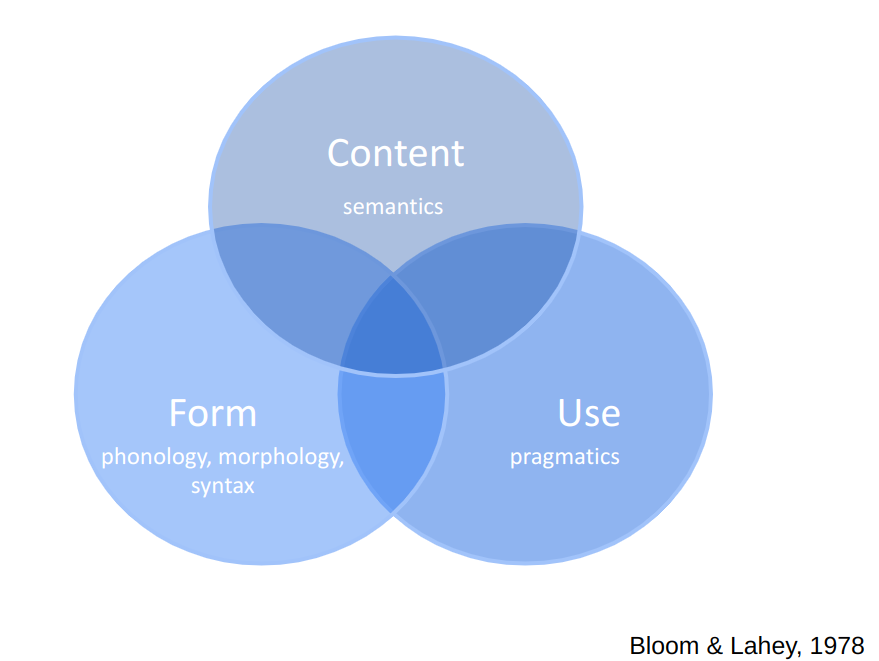
The authors of this paper argue that the development of listening proficiency in a new language is based on phonological vocabulary knowledge, which comprises three different stages—phonologization, generalization, and automatization. According to the authors, “phonologization and generalization are connected to the form-meaning aspect of vocabulary knowledge, whereas automatization corresponds to the use-in-context aspect.”
This paper examines gaining vocabulary knowledge through the specific aspects of:
- Phonologization: Recognizing words aurally without orthographic cues.
- Generalization: Recognizing words regardless of the speaker.
- Automatization: Quickly determining the semantic and collocational appropriateness of words in various contexts.
The interesting finding here (to me) was how important automatizing vocabulary knowledge was to enhancing listening proficiency in a new language. This suggests that teachers should not only focus on word recognition but also on the ability to use vocabulary in varying contexts and with different speakers.
I think this is important because while the message that teaching vocabulary is important has broadly made its way to the field, I think the message that it needs to be not merely taught, but seen, heard, and read in varying contexts – and most importantly, actively used by students in varying contexts. Within a lesson, this means drawing attention to and using key vocabulary before, during, and after reading a core text, and this is a great place to start. But clearly, one lesson won’t be enough. That key vocabulary then needs to be spaced and interwoven in practice and use throughout the remainder of the unit of study! Some of this may be explicit, especially when first introducing words, but much can also be implicit if the vocabulary is aligned to and key to understanding the topic that all the content, texts, and discussions are oriented around.
The more that students can hear, see (the word in print), speak, and write those key words, they more that they will stick!